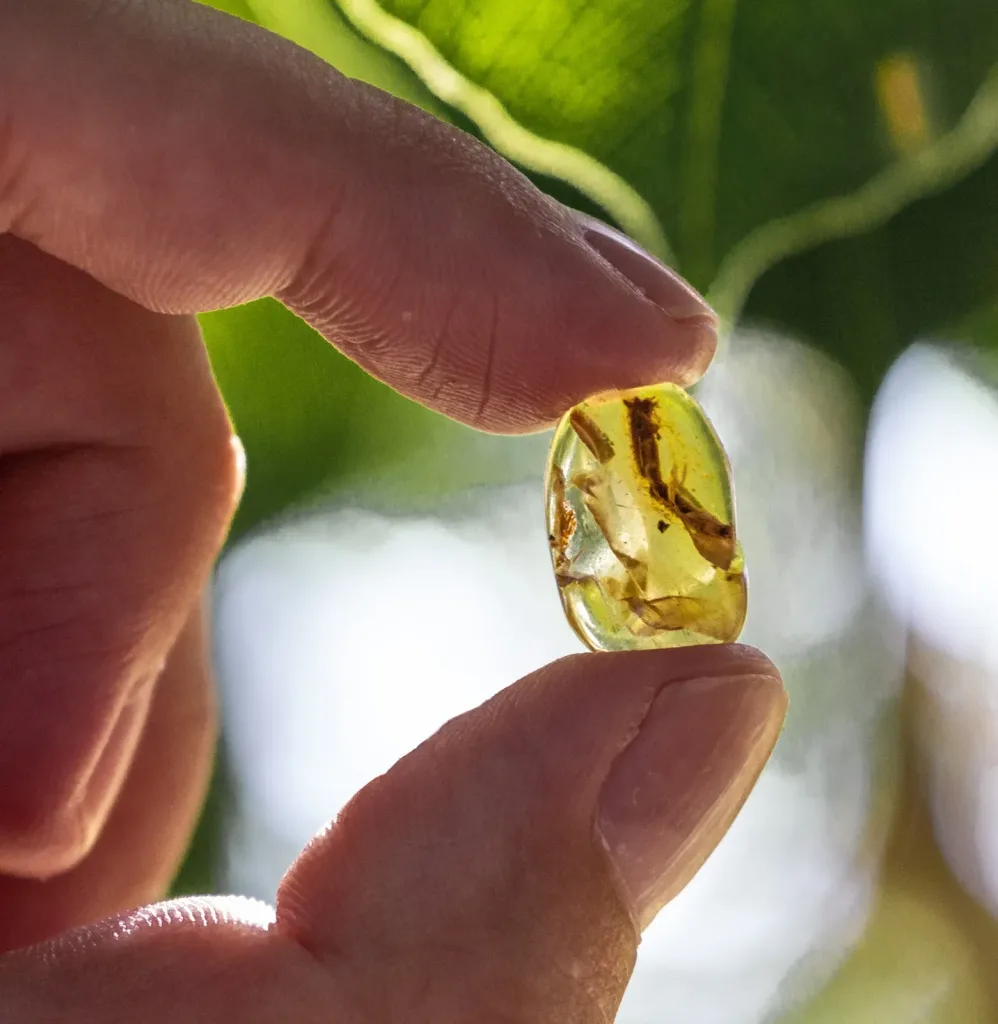
Jerusalem, 25 October, 2026 (TPS-IL) — A piece of amber from northern Myanmar, about the size of a fingertip at 18 millimetres long, holds what researchers call the best-preserved direct fossil evidence of a lizard deliberately dropping its tail. The tail broke away roughly 99 million years ago. The Tel Aviv University study describing it appears in Palaeontologia Electronica.
Shedding the tail, known as autotomy, is one of the most common ways living lizards evade predators. Even so, scientists have struggled to work out when it first appeared. Earlier fossils showed fracture planes in tail vertebrae and tails that had regrown. Those features suggest an animal could lose its tail, but fracture planes do not always prove it did so voluntarily.
The new specimen went unrecognised for years. Dolev Fabrikant, a PhD candidate at the university’s New Environmental School, took a closer look at what seemed to be a twig or an insect fragment. The object was covered in tiny scales, and he realised it was a lizard’s tail. His supervisor, Dr Leonidas-Romanos Davranoglou, said he nearly jumped out of his chair on hearing the news. The pair led the study with colleagues from the National and Kapodistrian University of Athens and Israel’s Volcani Institute.
Because the amber is cloudy, an ordinary microscope revealed little. The team used micro-CT scanning at the Volcani Institute, which combines X-ray images taken from many angles into a three-dimensional reconstruction. That let them examine the fossil’s hidden structures without cutting the one-of-a-kind specimen open, according to Dr Ahmed Nasser, who heads the institute’s analytical unit.
The scans showed a distinctive ring of tissue at the point of separation, resembling the structure in tails dropped by living lizards. The break was also fairly clean and symmetrical, without the damage expected from an accidental injury.
Several questions remain. Without a skull or other skeletal features, the animal’s group cannot be identified. Apostolos Christopoulos of the Athens team says the candidates include the group that contains today’s wall lizards, or slow worms and monitor lizards. The reason for the loss is also unclear. The lizard may have been stuck in sticky resin and detached its tail to break free, or it may have shed the tail during a predator attack, after which the tail landed in the resin. Whether the animal survived or regrew its tail cannot be determined from the fossil.
What the fossil does show is that the mechanism was already working in lizards about 99 million years ago. It is a survival strategy that still plays out today on walls and in gardens.