Jerusalem, 21 October, 2026 (TPS-IL) — Prediction markets allow people to bet money on the outcome of future events, from elections and military conflicts to economic and technological developments. But while these markets can accurately estimate the overall likelihood of events, they may systematically misjudge the odds of specific outcomes, a new Tel Aviv University study of more than one million forecasts has found.
The findings matter because prediction markets are increasingly used to gauge the likelihood of major political and global events. Their odds may look precise, but the study suggests they should not always be taken at face value: understanding where markets tend to overstate or understate the chances of an event can be just as important as knowing how accurate they are overall.
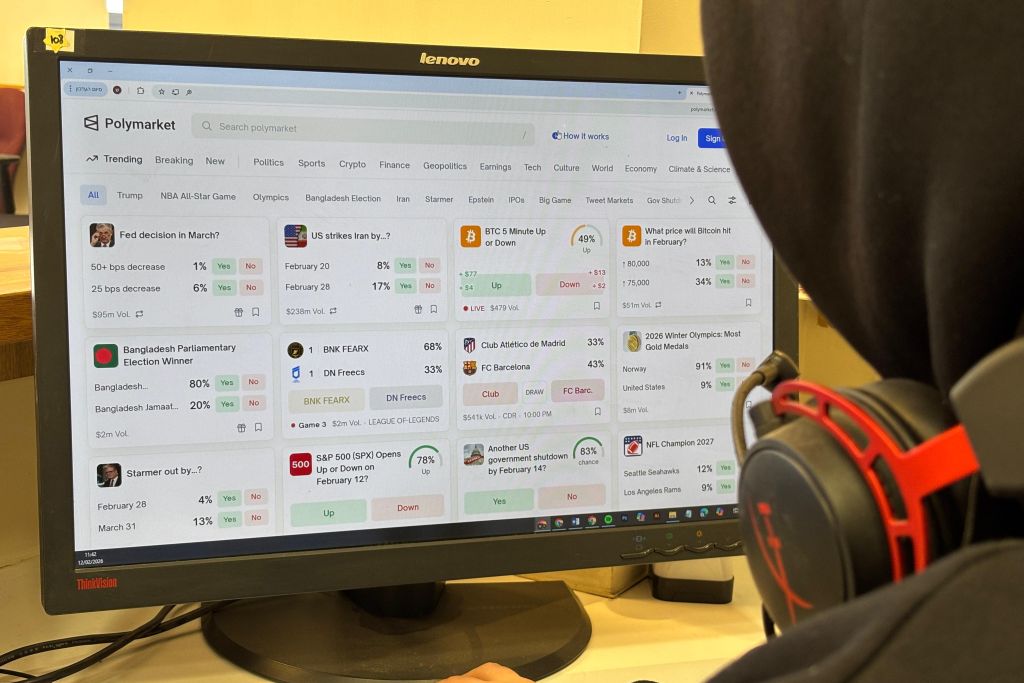
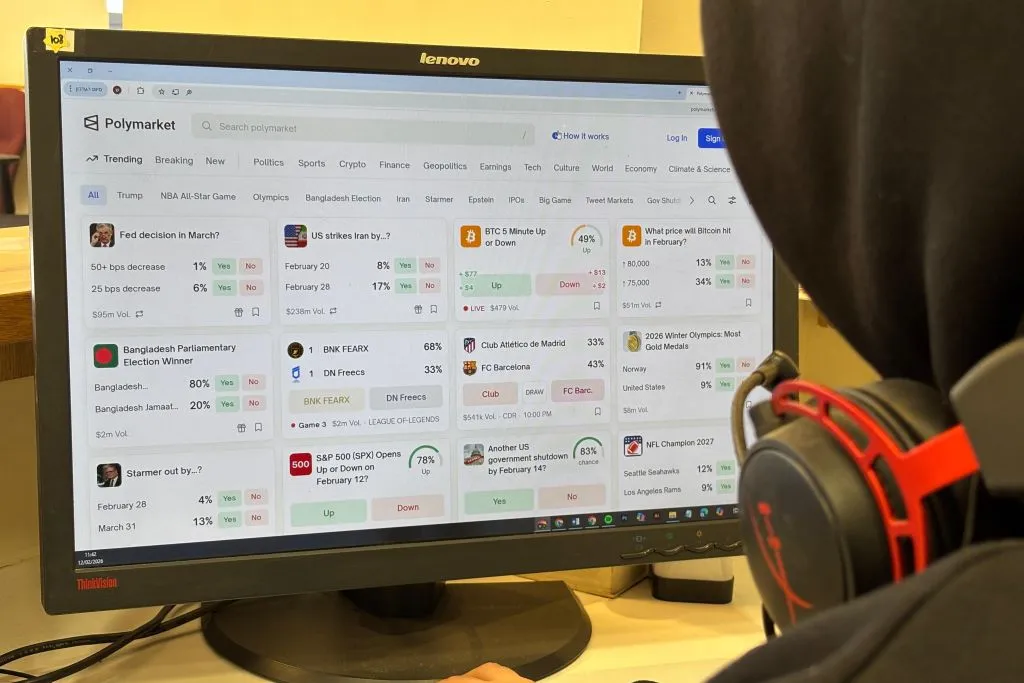
An Israeli looks at the Polymarket gambling site on Feb. 12, 2026. Photo by Yoav Dudkevitch/TPS-IL
Prediction markets have grown into a multibillion-dollar industry, with millions of users and billions of dollars changing hands each month. Polymarket recorded more than 600,000 active traders in April 2026, while rival Kalshi reported about two million monthly active users. Combined monthly trading volume on the two platforms reached $53 billion in July 2026, up from approximately $26 billion in May, according to a Pew Research Center analysis.
The researchers found that prediction markets tended to overestimate the likelihood of events involving security, military affairs, geopolitics and technology, while underestimating certain election-related outcomes.
The study, published in the Proceedings of the National Academy of Sciences (PNAS), analyzed 1,014,122 forecasts collected over a decade from four platforms: Polymarket, Kalshi, Manifold and Metaculus. Its central finding is that the reliability of prediction markets depends partly on what they are forecasting, revealing systematic biases that can be obscured by strong overall performance.
Across the full dataset, predicted probabilities closely tracked actual outcomes. Events assigned a 70% chance of occurring generally happened at approximately that rate, indicating that markets were well calibrated overall. However, forecasts involving security, military affairs and conflict, geopolitics and international relations, and technology systematically assigned higher probabilities to events than their eventual outcomes warranted.
Election-related forecasts showed a different pattern. Markets tended to underestimate the likelihood of certain election outcomes across parts of the probability range, particularly when assigning low or intermediate probabilities.
The researchers also examined how forecast performance changed as deadlines approached. Predictions became more informative over time, primarily because markets improved at distinguishing events that would happen from those that would not, rather than because their overall calibration improved.
Notably, strong calibration was already evident after just 25% of a forecast’s allotted period had elapsed and persisted through later stages.
The findings offer a caution for journalists, analysts and policymakers who use prediction markets to assess geopolitical risks. The findings suggest that prediction markets are more reliable for some types of events than others, making it important to consider their track record in each area, the researchers said.