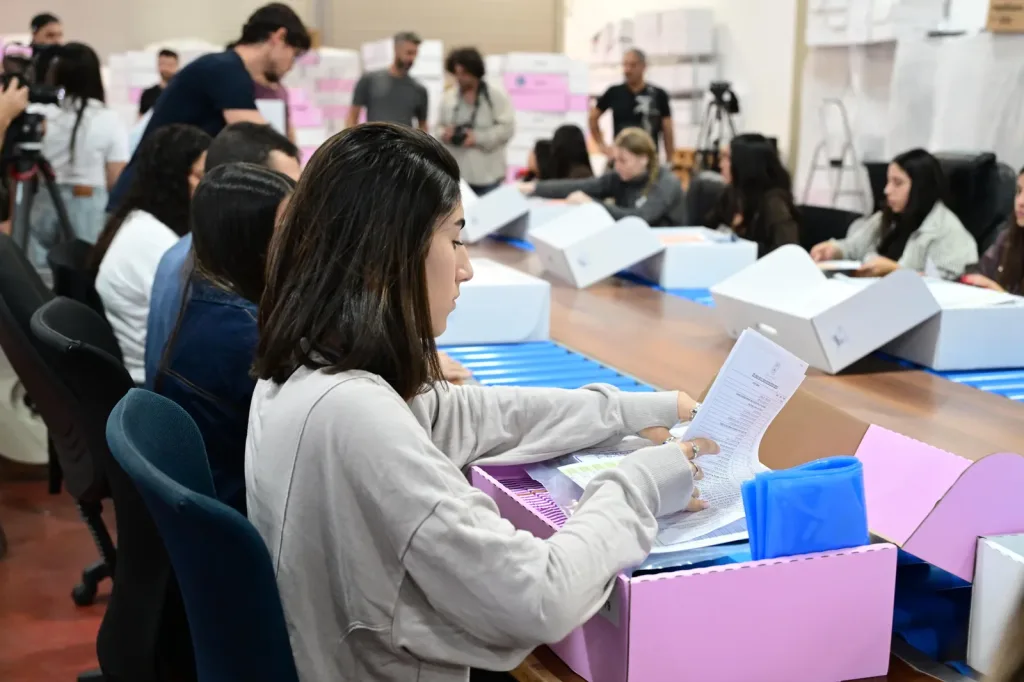
Jerusalem, 16 October, 2026 (TPS-IL) — Foreign influence campaigns seeking to undermine confidence in Israel’s Oct. 27 election are adding to the pressure on election officials, with the acting head of the Central Elections Committee warning that the volume of legal challenges has already reached unprecedented levels.
“We’re not finished yet,” Din Livne, the committee’s acting director-general, said Friday, noting that the number of petitions before the committee chairman equals five election cycles.
Livne said an “influence operations war room” would operate on Election Day in coordination with Meta, Microsoft, Google and other major platforms. Campaigns intended to undermine the proper conduct of the vote, he said, “will be removed immediately.”
The effort comes amid growing evidence of foreign attempts to exploit Israel’s political divisions. Researchers have documented influence operations since the Hamas-led Oct. 7, 2023, massacre and the ensuing war. Iran has pursued campaigns aimed at weakening governments and deepening social rifts, while Russia has intensified its influence operations since its invasion of Ukraine.
Shin Bet chief David Zini told lawmakers in a closed Knesset briefing in July that Iran was the main foreign actor seeking to interfere in the election. Russian and Chinese activities were also reportedly discussed.
The objective, officials and researchers say, is not necessarily to change votes but to weaken public trust through disinformation, online manipulation and cyberattacks.
Research by the Institute for National Security Studies found that Iranian actors pursued contradictory tactics around Israel’s 2022 election, encouraging Arab citizens not to vote while simultaneously promoting claims that the election had been stolen. In March 2026, the Diaspora Affairs Ministry identified an active Iranian campaign in Hebrew designed to spread fear and division.
The open-source intelligence research group Golden Owl reported that fake Israeli personas on X linked to Iran generated approximately 950,000 views in 30 days. Its election monitoring also identified 237 suspicious accounts.
The Israeli nonprofit watchdog FakeReporter, which investigates disinformation and foreign influence operations, said the campaigns target voters across the political spectrum. Most of the identified operations were linked to Iran, with others attributed to Russia. One image circulated by supporters of Prime Minister Benjamin Netanyahu as evidence of incitement against him was traced to an account apparently connected to an Iranian operation.