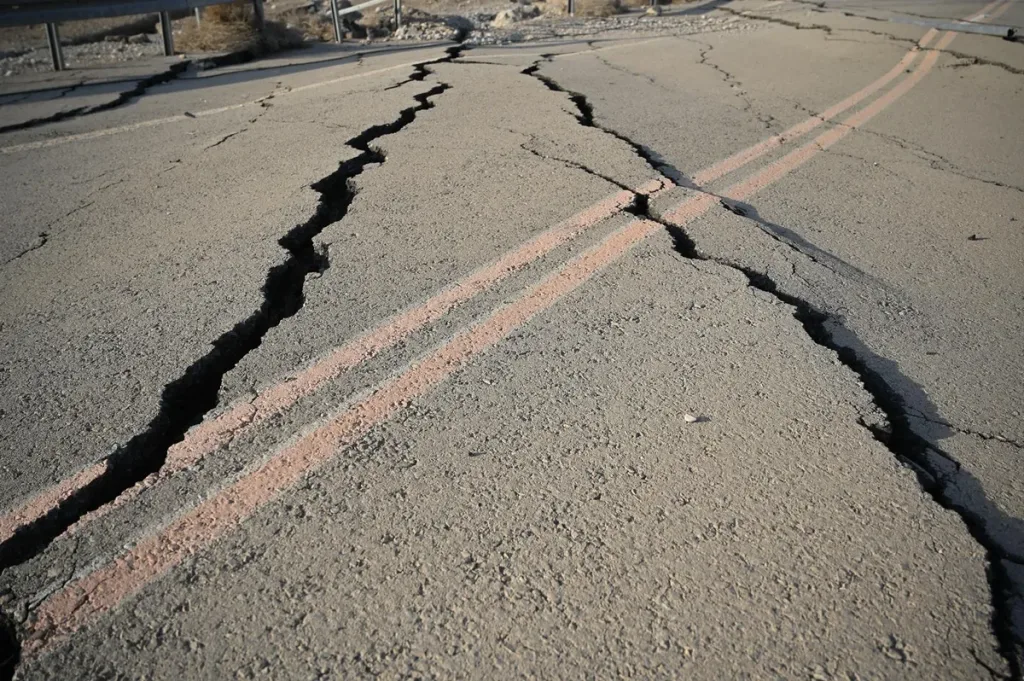
Jerusalem, 9 September, 2026 (TPS-IL) — A new study by Israeli and international researchers could eventually help engineers detect when materials are beginning to fail, before a visible crack suddenly tears through them.
The researchers found that fractures can begin with tiny damaged regions that expand slowly before transforming into a rapidly growing crack. The finding could give engineers a potential way to identify developing failures earlier. The same mechanism may also shed light on how earthquakes begin, although detecting these slow-moving precursors remains a major challenge.
The study was led by Yuval Paz and Prof. Jay Fineberg of the Hebrew University of Jerusalem’s Racah Institute of Physics, together with Meng Wang of the Beijing Institute of Technology and Mokhtar Adda-Bedia of CNRS/ENS de Lyon.
To the human eye, glass or plastic can appear to break instantly. But much of the fracture process occurs before the final break. Under sufficient stress, a tiny damaged region forms inside the material and, rather than immediately becoming a crack, slowly expands outward.
“Our study merges 3 separate questions that are important to people studying materials and their stability and strength,” Fineberg told The Press Service of Israel.
Scientists have long understood how cracks behave once they begin moving rapidly, but explaining how a crack starts has been more difficult. The study provides a mechanical explanation for this early stage, which scientists call “creep.”
“If you think about it, this is the natural way that a defect in a material should always form,” Fineberg explained to TPS-IL.
The researchers sought to understand how a small flaw, initially much smaller than the material itself, grows until it cuts all the way through. Their experiments showed that the damaged region expands extremely slowly, at speeds ranging from microns to millimeters per second, and accounts for at least 75% of the entire fracture process.
The critical transition occurs when the damaged region reaches the material’s full thickness.
“The patch essentially changes its ‘topology’ when finally cutting through the material’s thickness,” Fineberg said.
In simpler terms, the damaged region begins as a small patch expanding around its edges. Once it cuts completely through the material, it becomes a conventional crack. At that point, the crack requires far less energy to continue growing and can accelerate rapidly.
From Flaw to Fracture
The researchers also found that fractures can begin at a much smaller size than predicted by traditional fracture theory: roughly 0.1 millimeters, compared with a traditional critical size, known as the Griffith length, of about 1 millimeter.
The finding suggests that the stress acting on a material, as well as the size and geometry of an existing flaw, plays a role in determining when a fracture begins.
“The underlying basis of the theory is entirely general and is simply related to the geometry of the flaws or cracks,” Fineberg told TPS-IL. “Our theory’s strength is in its simplicity. We have simply accounted correctly for the influence of the crack’s geometry.”
The findings could also offer insight into earthquakes, which occur when stresses along faults overcome the forces holding tectonic plates in place, causing the plates to suddenly slip.
“Since earthquake dynamics and the process of fracture are (mathematically) the same, our findings predict how the precursors to earthquakes should behave,” Fineberg told TPS-IL.
The researchers’ findings suggest that an earthquake rupture could similarly begin with a slowly expanding region before suddenly accelerating. Fineberg said his team has previously observed a similar transition in research on friction.
The findings do not mean scientists can currently predict earthquakes or determine exactly when a material will fail. The major challenge is detecting these slow-moving regions before catastrophic failure occurs.
“Because they are so slow, they don’t make any ‘noise’ while expanding,” Fineberg told TPS-IL, making them difficult to detect through sound or seismic signals.
If researchers can eventually develop reliable ways to detect these precursors, the findings could have practical applications.
“If we succeed, we may be able to extend the usable lives of materials or, in the case of earthquakes, to possibly provide early warning that they are starting,” Fineberg told TPS-IL.
The study was published in the peer-reviewed journal Physical Review Letters.