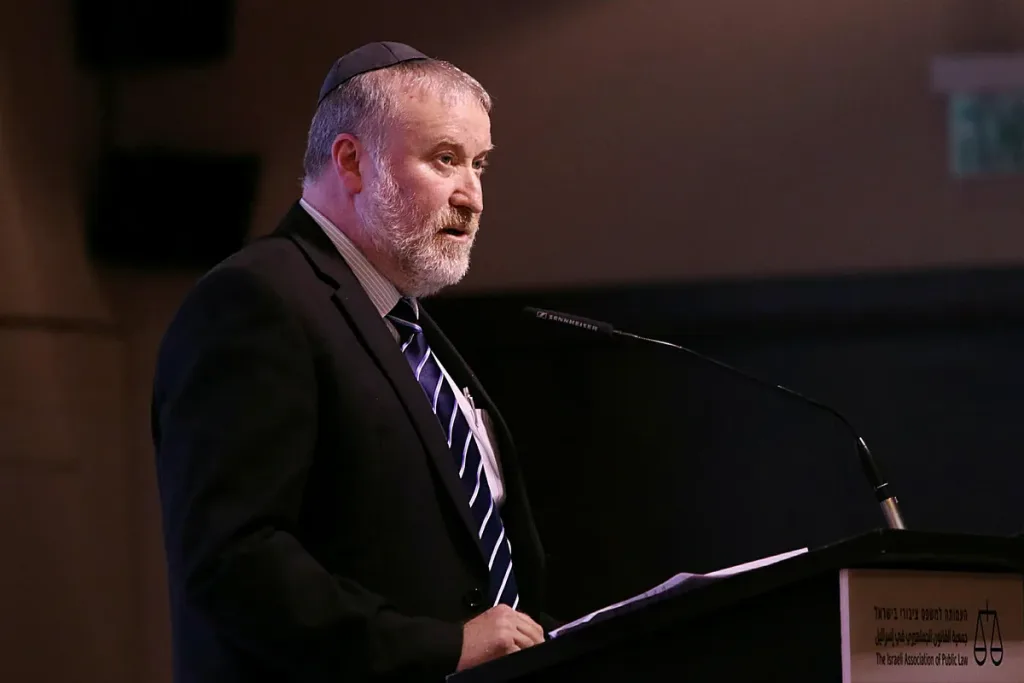
Jerusalem, 11 October, 2026 (TPS-IL) — Avichai Mandelblit, the former attorney general who decided to indict Benjamin Netanyahu, returned to the Jerusalem District Court on Sunday as a Defense Witness. By one count, checked against the full transcript, he answered “I don’t know” 16 times during his testimony, and said “it could be” another 24 times. Some of these answers went to issues at the center of the defense case.
Seven years after announcing his decision to indict the Prime Minister in Cases 1000, 2000 and 4000, Mandelblit appeared for the defense, not the prosecution. Netanyahu denies the charges. His lawyers, Amit Haddad and Noa Milstein, are expected to question Mandelblit over seven non-consecutive hearing days, a few weeks before the national elections. Netanyahu attended part of Sunday’s session.
The defense argues that key investigative steps were taken without the approval Israeli law requires for a criminal investigation of a sitting prime minister, or went beyond the approvals that were granted.
The sharpest exchange concerned the amended indictment in Case 4000. Haddad showed Mandelblit the original and amended versions and argued that the signatures looked identical, suggesting the first had been copied onto the second.
Mandelblit said he had a vivid memory of signing the original but no factual recollection of signing the amended version. “I don’t know if I signed,” he said. He rejected Haddad’s conclusion, saying he relied on memory, not speculation. The signature claim is the defense’s allegation, and the court has made no finding on it.
The session was heated. Prosecutor Yehudit Tirosh objected to some lines of questioning, saying they strayed into the prosecution’s litigation decisions, and traded sharp words with the bench. Reports described Mandelblit rubbing his eyes, holding his head, and drinking water as the pressure mounted. “I’m taking hits from every side,” he said at one point.
IS FAVORABLE PRESS A FORM OF BRIBERY?
Haddad also pressed Mandelblit on the 315 incidents of alleged favorable media coverage listed in the amended Case 4000 indictment, which the prosecution argued was a form of bribery. Mandelblit confirmed he had reviewed the document but said he did not remember raising questions. He acknowledged he had not examined the raw material behind the list.
Haddad argued that Netanyahu was never questioned about the vast majority of the incidents. Mandelblit said he did not know whether that was true, adding that he does not follow the trial closely. Presiding Judge Rebecca Friedman-Feldman asked whether he had not checked. “No,” he answered. Haddad called that his responsibility, not the prosecutors’.
Mandelblit also conceded some defense points. He said he never approved every investigative step and did not expect to. He wanted the main actions brought to him, given the sensitivity of investigating a prime minister. Asked directly whether some actions were taken without his approval, he said yes. He agreed with Haddad that some were serious oversights.
He described one case in which he reacted angrily: a wiretap on Natan Eshel, a member of Netanyahu’s circle, which he said he learned of afterward. He said he ordered it stopped and told the police to come to him first in the future. Asked whether he had ever said the police acted behind his back, he replied, “It could be.”
He also confirmed that his approvals for the investigations were given orally and recorded in meeting minutes, not in standalone written decisions. He had believed at the time that no written approval was required. The court later ruled otherwise, he said, and he respects that ruling.
Haddad devoted much of the afternoon to a memo Mandelblit signed on January 5, 2021. The court had ordered the prosecution to hand over the original approvals “in the existing format.” Instead, the prosecution submitted the memo.
Mandelblit said he believed the memo satisfied the court’s order and that the judges ruled differently. He said he had not written it but stood behind its contents and had read it before signing. He did not remember with certainty whether he had checked its details against the originals, saying only that, to the best of his recollection, he had.
Haddad accused the prosecution of misleading the court and said he would argue bad faith. “I deny that claim,” Mandelblit said when Haddad suggested he knowingly chose not to comply.
Legal significance will be decided by the three judges, not by the count of “I don’t know” answers. Mandelblit’s memory lapses and his admission that some police actions were never approved give the defense material for its argument that the investigations were improperly supervised. The prosecution maintains that the required approvals were given lawfully, and it will question Mandelblit after the defense finishes. Calling him as a defense witness does not mean his testimony supports the defense’s claims.
The hearings continue, and the court ordered the full transcripts to be made available to the parties on Monday.