




By David Israel • September 24, 2026
Jerusalem, 24 September, 2026 (TPS-IL) — Eliran Nachmias is a school teacher who for the past 15 years has been renting the basements of two synagogues in Netanya and spends the weeks before the holiday of Yom Kippur selecting sets of the “Four Species” mentioned in the Bible in connection with the holiday of Sukkot.
During the week-long holiday, Jews take a date palm branch, an etrog (citron), boughs of myrtle, and willow branches during prayers. This ancient religious tradition is also the centerpiece of a highly specialized seasonal business, with growers, wholesalers, retailers and consumers all playing a role in a market that operates under a tight deadline.
“The growers bring the produce to warehouses around the country, particularly in Bnei Brak and Jerusalem,” Nachmias told TPS-IL. “Those warehouses hold hundreds of thousands of sets. About a week before Rosh Hashanah, the retailers and small merchants arrive and begin sorting the etrogim. A merchant might buy anywhere from 200 to 500 sets, or even 1,500 sets, and then sell them directly to consumers.”
Jewish media reports have estimated the global Four Species market at $40 million to $60 million before Sukkot as millions of Jews buy sets that run from $50 to hundreds and even thousands of dollars. But the market is not easily gauged, because sets are not priced like ordinary produce. Instead, prices depend on religious standards and aesthetic qualities. A blemished etrog may be worth very little, while a flawless, beautifully shaped etrog with an intact stem can make a four-species set cost many times more.
A Four-Day Selling Season
There is also a time factor. The Four Species market operates mostly during the four days between Yom Kippur and Sukkot and must close by the afternoon before Sukkot begins. As the deadline approaches, sellers face increasing pressure to lower their prices rather than be left with sets that will have little or no value once the holiday begins.
Ron Nave manages three stands selling the four species for an outfit that rents them from the Ra’anana municipality, near Tel Aviv. He told TPS-IL, “On the one hand, you have few days to sell. On the other hand, demand is limited. So, whenever someone comes to the stand, we try to understand how we can best help them. You also learn that customers arrive in waves at certain hours, and other hours are quieter. You have to know when to take a break and when to be ready for the next wave.”
This year, vendors’ attention is focused on Friday at 2:00 p.m., when the etrog markets traditionally close down until next year.
“I’ve been working in this business for several years, and so far, we’ve always managed to sell the merchandise through to the end,” Nave said.
“Whether prices actually fall as Sukkot approaches, depends on where you are,” Nachmias explained. “In the Netanya market, there is a very clear pattern. By 11 a.m. on the eve of Sukkot, sellers have already started lowering their prices. As the closing time approaches, the prices continue to fall because the police are going to shut everything down at 2 p.m. In the end, some sellers can reach prices that are essentially cost.” The 2:00 p.m. closure is mandated by the municipality.
However, Nachmias added that in Hasidic communities where an etrog can cost more than NIS 200-300 ($66-$100), prices generally do not come down. “The price stays fixed until the end. There is no price reduction. The price is the price.”
“I know sellers who have been left with 200 or 300 sets and still refused to lower the price by even one shekel. The merchandise goes to waste, but customers know that the seller cannot be manipulated. They understand that the price is the price,” he said. “In the end, it is a matter of personality.”
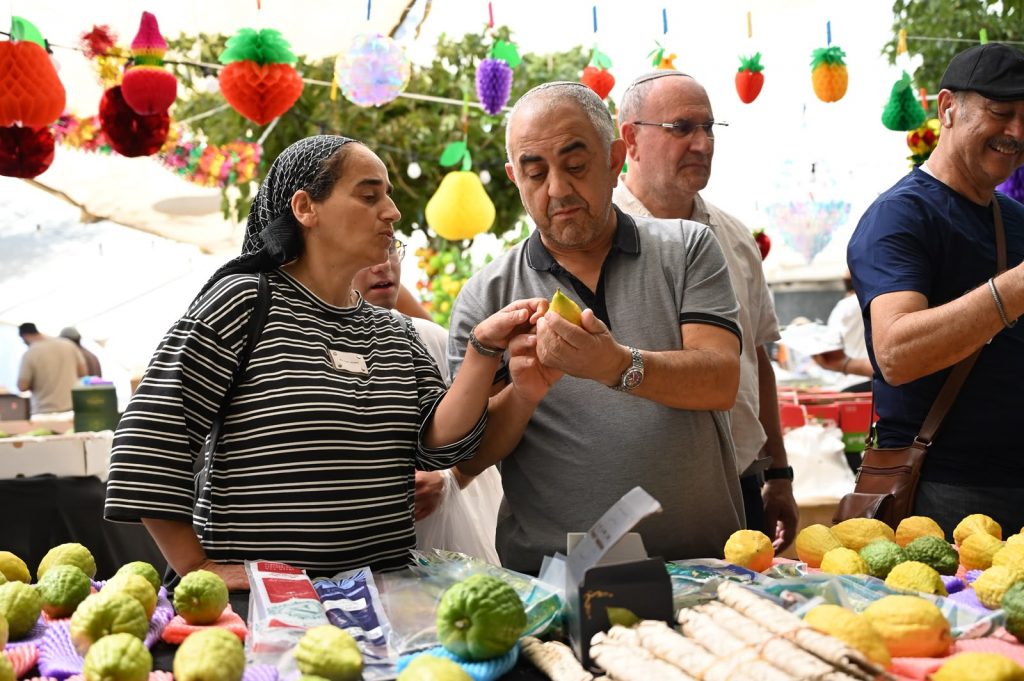
An Israeli couple in Jerusalem inspect a etrog (citron) on Sept. 22, 2026. Prices depend on religious standards and aesthetic qualities. Photo by Yoav Dudkevitch/TPS-IL
The Moroccan Etrog Boom
In recent years, the Moroccan etrog has become a much bigger part of the global four-species market thanks to a quirk in the Jewish calendar called shemita. This Biblical command requires the land of Israel’s agricultural produce to become ownerless every seven years.
“A major turning point was the last shemitah year” of 2021, Nachmias said.
During the shemitah year, rabbinic authorities purchase all the Sukkot produce in Israel, compelling vendors to sell the etrogim in closed boxes at predetermined prices. Etrogim grown outside Israel are not subject to those restrictions.
“Once people became familiar with that style of etrog and liked what they saw, many continued buying them even after the shemitah year,” Nachmias explained.
Moroccan etrogim are more expensive than their Israeli-grown counterparts, costing NIS 250-1,000 ($82-$328).
He said today, there are tens of thousands of Moroccan etrogim on the market.
“There isn’t usually as much drama with the hadassim (myrtles) or aravot (willows),” said Nachmias.
Hadassim and aravot are vacuum-packed, often several months before sale. They begin to lose their luster soon after being pulled out of the packing, which accounts for the minor market of replacing the boughs during Sukkot’s intermediate days.