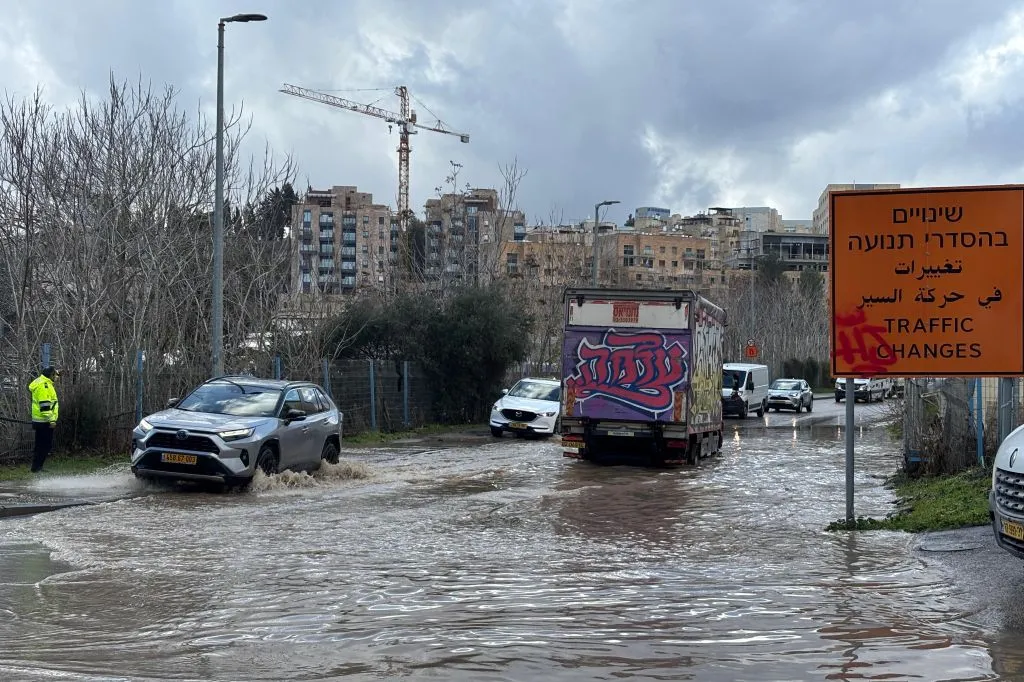
Jerusalem, 12 November, 2026 (TPS-IL) — Cities in some parts of the world could face more severe flooding even as they receive less rain overall, because climate change is expected to concentrate rainfall into shorter, more intense storms, a new study by Israeli researchers has found.
The findings suggest that cities preparing for a drier future could be underestimating their flood risk. Drainage systems designed around historical rainfall patterns may struggle to handle increasingly intense downpours, while expanding roads, buildings and paved surfaces leave less ground to absorb the water. The result could be a costly double challenge: less water available overall, but more destructive flooding when storms hit.
The research, led by Raz Nussbaum, a doctoral student at the Hebrew University of Jerusalem, estimates that by the end of the century, 26% of the world’s urban areas — home to approximately 1.5 billion people today — could experience declining overall precipitation alongside increasingly intense extreme rainfall.
The findings challenge the assumption that less rainfall necessarily means less flood risk. Instead, the researchers found that weaker runoff events are expected to become weaker, while the strongest events — those most likely to cause serious flooding — could become more powerful. Urban development could further amplify the danger.
“Climate change is not simply making cities wetter or drier. It is fundamentally changing how rain falls,” Nussbaum said. “Some regions are expected to receive less rain overall, but in shorter, more intense bursts. Our findings suggest that in these regions, the most extreme floods could become even more extreme.”
More Intense Downpours
Published in the peer-reviewed Journal of Hydrology, the study analyzed projections from 32 global climate models under a high-emissions scenario. The researchers then conducted detailed simulations in central Israel to investigate how these changing rainfall patterns could affect urban flooding.
They focused on the Nahal Ra’anana catchment area and conducted more than 5,300 simulations of heavy rainfall under different climate and urban-development scenarios.
The simulations revealed a particularly significant change in the intensity of short downpours. Maximum rainfall intensity over a 10-minute period in the Ra’anana area increased by approximately 20% in the future-climate simulations, even as longer-duration rainfall and total precipitation declined.
The figure does not mean that actual floods in the area have already become 20% more severe. Rather, it shows how much more intense the heaviest short bursts of rain could become under the projected future climate.
Intense rainfall can overwhelm urban drainage systems even when a region receives less rain over the course of a season or year. The problem is compounded by urban development: roads, rooftops, parking lots and other paved surfaces prevent water from soaking into the ground, increasing the volume and speed of runoff. The researchers found that denser development further amplifies extreme runoff, particularly at the neighborhood level.
“Urban flood protection will therefore need to be rethought, and not only because of climate change,” Nussbaum said, pointing to population growth and urban densification as additional factors that increase runoff and expose more people to flood risk.
The researchers said cities should adapt drainage infrastructure to handle short, intense storms while making greater use of green spaces and water-retention systems that allow rainwater to soak into the ground or be temporarily stored.
Although the detailed flood simulations focused on the Ra’anana catchment area and require further investigation elsewhere, the global analysis identified similar projected rainfall shifts in parts of the Mediterranean, western and southern Africa, southeastern Australia and the Americas.
The findings could help municipalities update flood-risk maps and urban-planning policies to account for changing rainfall patterns. Measures could include upgrading storm drains, underground pipes and drainage channels, preserving green spaces, and requiring new developments to incorporate permeable surfaces, green roofs and water-retention systems.