


By David Israel • September 2, 2026
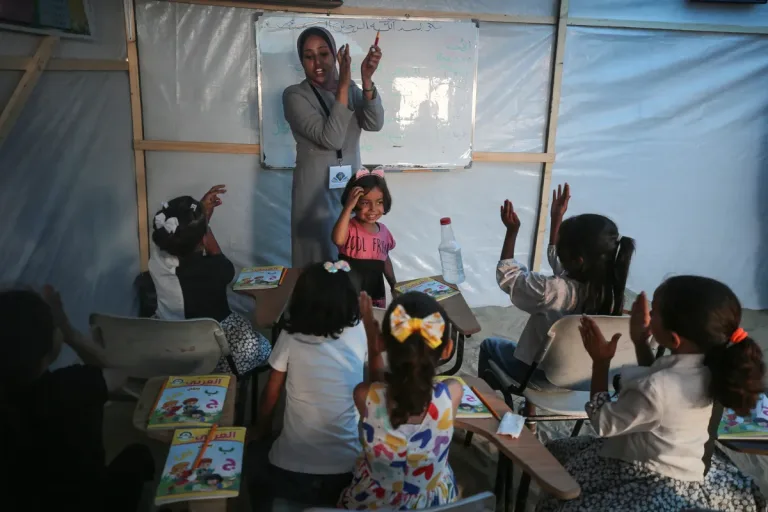
Jerusalem, 2 September, 2026 (TPS-IL) — More than 834,000 Palestinian students in Judea and Samaria are beginning a new school year with textbooks that an Israeli education watchdog says continue to glorify terrorists and promote violence, including in subjects such as mathematics, science and language.
Arik Agasi, COO and researcher at at the Institute for Monitoring Peace and Cultural Tolerance in School Education (IMPACT-se), told The Press Service of Israel that Palestinian school textbooks contain extensive references to violence, antisemitism and jihad.
One example is Dalal Mughrabi, who participated in the 1978 Coastal Road massacre, the deadliest terrorist attack against Israelis before the Oct. 7, 2023, Hamas attack. Terrorists hijacked a bus and took passengers hostage, killing 38 Israeli civilians, including 13 children. Mughrabi and eight other terrorists were also killed in a gun battle.
“The textbook describes the bus massacre and what she did, and presents it in a glorified way,” Agasi told TPS-IL. Mughrabi is featured in fifth-grade reading comprehension and language lessons.
Another eighth-grade story, he said, glorifies suicide bombers who wore explosive belts and killed Israelis. The material appears in reading comprehension and grammar lessons.
Agasi said violence is incorporated into seemingly neutral academic subjects. Students learn addition and subtraction by counting “martyrs,” while Newton’s law of gravity is illustrated with a slingshot aimed at Israeli soldiers.
In biology, he said, students study an image of Muhammad al-Dura, a Palestinian boy whose death in Gaza in September 2000 became the subject of a long-running dispute over whether Israeli forces were responsible. The textbook used the image to illustrate the body’s response to being shot, including changes in heart rate and the nervous and urinary systems.
IMPACT-se studies school textbooks worldwide against international standards for acceptance of others, peace and tolerance, based on UNESCO standards and international education conventions. Agasi said IMPACT-se has repeatedly reviewed the books, and found a “very serious deterioration” in the newer editions.
“We saw the removal of all attempts to promote peace with Israel that had previously appeared in the textbooks,” Agasi said. “Anything positive, and there wasn’t much of it, was removed.”
Calls for Reform
In 2016, under growing international pressure, the Palestinian Authority (PA) completely rewrote its textbooks covering every grade and subject. Today, the same books, produced by the Palestinian Education Ministry in Ramallah, are taught throughout the Palestinian territories in schools operated by the PA, the United Nations Relief and Works Agency (UNRWA) and Hamas.
“In other words, Hamas doesn’t have its own textbooks, and UNRWA doesn’t have its own textbooks,” Agasi explained. Instead, “they all use textbooks produced by the Palestinian Education Ministry in Ramallah and distributed both digitally and in printed form to all schools, without exception.”
“The textbooks containing all the examples I gave you were produced with European taxpayers’ money as far back as 2016,” Agasi told TPS-IL.
In 2021-2022, the EU temporarily froze part of its financial support to the PA amid pressure for curriculum reforms. The funds were released in June 2022 without a formal agreement detailing changes to the textbooks, according to a Knesset report on Palestinian educational materials and their treatment of Jews, Israel and peace.
Agasi said the Palestinians promised in 2024 to reform the curriculum under pressure from the international community, particularly the EU.
In July 2024, the EU agreed to provide the PA with €400 million ($460 million) in emergency financial support. It later announced a €1.6 billion ($1.85 billion) package for 2025-2027, including about €620 million ($719 million) in direct aid through the PEGASE mechanism. The EU did not specifically earmark the money for rewriting textbooks, but linked the broader package to a Reform Matrix requiring benchmarks in areas including governance, financial management and education.
“We have been reporting for many years on these textbooks and what they could produce if the international community that funds them failed to address the problem,” Agasi said. “Unfortunately, our warnings were not heeded. Then we saw October 7. These books clearly helped create the environment that led to it.”
PA schools in Judea and Samaria begin on Sept. 6 while classes in Gaza start on Sept. 19.