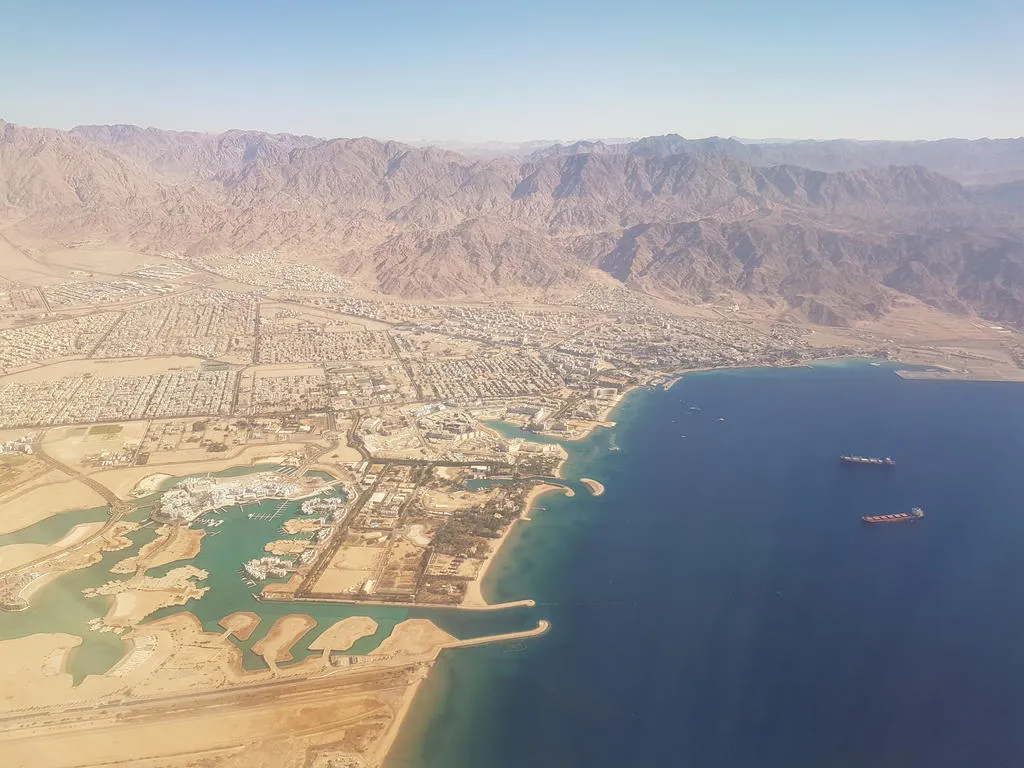
Jerusalem, 19 November, 2026 (TPS-IL) — Jordan on Wednesday broke ground on one of the largest infrastructure projects in its history. The seawater desalination and conveyance scheme is meant to ease one of the world’s worst water shortages and reduce the kingdom’s dependence on outside suppliers, chiefly Israel.
Prince Faisal bin Hussein, brother of King Abdullah II, launched the National Water Carrier Project at a ceremony in the Red Sea port of Aqaba. Prime Minister Jafar Hassan attended. Israeli news outlets put the price tag at roughly $6.6 billion.
A plant on the Gulf of Eilat (Aqaba) will produce about 300 million cubic meters of drinking water a year, around 40 percent of Jordan’s drinking-water needs. A 417-kilometer (259-mile) pipeline will carry the water north to the capital, Amman, with pumping stations lifting it to elevations of up to 1,100 meters. Solar facilities are planned to supply about 30 percent of the project’s electricity.
A consortium led by French developer Meridiam, with Suez Group as technical and operational partner, is delivering the project. Ownership passes to the Jordanian government 26 years after operations begin. Construction is expected to take about four years, with water flowing in late 2030.
Water Minister Raed Abu Soud said the financing showed international confidence in Jordan’s investment climate. Hassan called it the country’s largest strategic project and said it would strengthen the kingdom’s water security and independence. He thanked the United States, the European Union, Germany and France for their support.
The timing is significant for Israel. Under the 1994 peace treaty, Israel supplies Jordan with 50 million cubic meters of water a year. A 2021 arrangement added a similar amount, but it was not renewed after it lapsed in late 2025. Israeli media link the launch to tensions between the two countries that deepened during the Gaza war.
Israeli analysts describe the project as a potential loss of strategic leverage for Israel, noting that the plant’s output would be about six times the extra water Jordan received from Israel each year. The less water Jordan needs from Israel, the less Israel can use water as a diplomatic lever.
The project also follows Jordan’s decision to shelve a “water-for-energy” deal. Under that plan, Jordan would have built solar capacity to supply electricity to Israel in exchange for 200 million cubic meters of desalinated water annually. The deal was abandoned in November 2023, over the Gaza war.
Israeli commentators are cautious about the claim of independence and stress that the shift will not come quickly. The project is at an early stage, and the first water is more than four years away. Even then, the 1994 treaty obligations stay in force, and Jordan still depends on Israel for natural gas. Some Israeli observers see the project more as a response to a sensitive dispute than as a clean break.
Environmental groups have raised other concerns. Critics argue the energy-intensive scheme could lock in demand for fossil gas, though the planned solar facilities are meant to cover part of its power needs.
The scale of Jordan’s need explains the urgency. The kingdom is among the driest countries on earth, and its population has been swelled by refugees. The carrier has been discussed for years and was originally slated for completion by 2027, so the 2030 date reflects significant delays.
For Jordan, the groundbreaking is a political statement as well as an engineering milestone. For Israel, it signals that Amman is preparing for a future in which it needs Israeli water less. How much influence Israel actually loses will depend on whether the project is delivered on schedule, which is far from certain given the delays so far.